
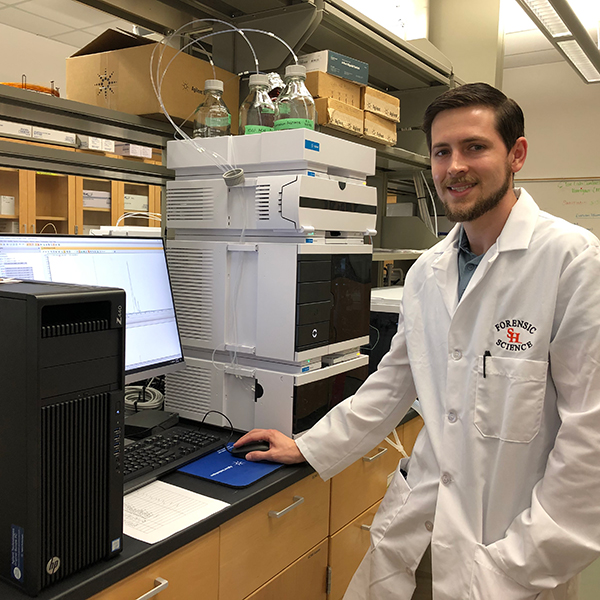
Dr. J. Tyler Davidson of the Forensics Department and Dr. Christopher Zall of the Chemistry Department were granted $14,000 through SHSU’s Office of Research Sponsored Programs to research the application of organometallic chemistry to the differentiation of hemp and marijuana. This grant is an interdisciplinary collaboration to develop a simpler, cheaper way to analyze and differentiate hemp and marijuana. In 2018, the federal government passed the Farm Bill, which distinguished hemp from marijuana based on the concentration of Δ9-tetrahydrocannabinol (Δ9-THC), which is the main psychoactive substance in cannabis. Any cannabis that contains 0.3% or less Δ9-THC based on a dry weight basis is defined as hemp, whereas any cannabis that contains more than 0.3% Δ9-THC is considered marijuana. This delineation between hemp and marijuana based on the Δ9-THC content has complicated the analysis of cannabis for forensic laboratories.
Current methodologies for the
determination of the Δ9-THC content from cannabis are expensive, time
consuming, and can lead to sample degradation. Drs. Davidson and Zall hope to
show the benefits of using organometallic chemistry to take advantage of subtle
differences in chemical structure that will allow for the rapid differentiation
of hemp and marijuana. Their proposed process would function as “a way to
improve the speed, efficiency, affordability, and ease of hemp and marijuana
differentiation.”
Dr. Davidson joined Sam
Houston State University as an Assistant Professor in the Fall of 2020 and has
been very involved with research that affects the criminal justice field. Dr. Davidson,
who earned his Ph.D. from West Virginia University, hopes this research will
"open up people's eyes about the potential impacts of organometallic
applications to forensic science.” The College of Criminal Justice is excited
to see the research from Dr. Davidson and Dr. Zall and how it will influence the
analysis of cannabis moving forward.
By: Allison Phillips